


Page 20 - SPEMD_59-1
P. 20
12                      rev port estomatol med dent cir maxilofac. 2018;59(1):10-17


           Materials and methods
           Information was obtained using a questionnaire that was
           completed by children from 3 to 11 years old who attended
           the S. Miguel Primary School (Escola Básica de S. Miguel), in Vi-
           zela, and another questionnaire that was completed by the
           corresponding  parents/guardians  for  validation  of  the  an-
           swers. To create the data extraction form and write the paper,   No. Respondents
           the authors conducted a comprehensive literature review us-
           ing the PubMed and Cochrane databases, as well as the Virtu-
           al Library of the University of Porto, introducing and combin-
           ing the following keywords “recurrent aphthous stomatitis”,
           “gastrointestinal”, “trauma”, “questionnaire”, “inquiry”  and
           “questions”. The following inclusion criteria were defined for
           the selection of the articles: full text available, publication in
           the last 5 years, and article written in English, Portuguese or
           Spanish. Subsequently, studies essential for a better under-              Age (years)
           standing of the subject were found in the references of the   Figure 1. Distribution of the sample by age group
           articles obtained in the first selection, and were included due
           to their relevance and extreme importance for the correlation
           between the results obtained and the existing knowledge in
           the literature.                                       The children’s responses were found to be in agreement
             A meeting was held with the Board of the Schools Group   with their parents’ responses, since the Cronbach’s alpha test
           of Infias (which includes the S. Miguel Primary School), in   gave alpha values higher than 80% for the seven questions that
           which the whole study was explained, and the authors were   allowed this validation.
           authorized to conduct it. Then, the questionnaires were deliv-  A prevalence of aphthae was found in 53.0% of the par-
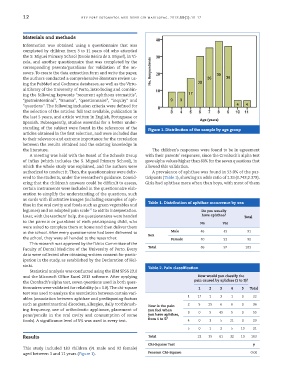
           ered to the students, under the researcher’s guidance. Consid-  ticipants (Table 1), showing an odds ratio of 1.33 (0.743;2.378).
           ering that the children’s answers could be difficult to assess,   Girls had aphthae more often than boys, with most of them
           certain instruments were included in the questionnaire elab-
           oration to simplify the understanding of the questions, such
           as cards with illustrative images (including examples of aph-
           thae in the oral cavity and foods such as green vegetables and   Table 1. Distribution of aphthae occurrence by sex
                                      22
           legumes) and an adapted pain scale  to aid its interpretation.            Do you usually
           Later, with the teachers’ help, the questionnaires were handed             have aphthae?    Total
           to the parents or guardians of each participating child, who              No       Yes
           were asked to complete them at home and then deliver them
           at the school. After every questionnaire had been delivered to   Sex  Male  46      45         91
           the school, they were all handed to the researcher.           Female      40        52         92
             This research was approved by the Ethics Committee of the
           Faculty of Dental Medicine of the University of Porto. Every   Total      86        97       183
           data were collected after obtaining written consent for partic-
           ipation in the study, as established by the Declaration of Hel-
           sinki.                                              Table 2. Pain classification
             Statistical analysis was conducted using the IBM SPSS 23.0
           and the Microsoft Office Excel 2013 software. After applying             How would you classify the
           the Cronbach’s alpha test, seven questions used in both ques-          pain caused by aphthae (1 to 5)?
           tionnaires were validated for reliability (α > 0.8). The chi-square      1    2   3    4   5   Total
           test was used to analyze the association between certain vari-
           ables (association between aphthae and predisposing factors          1   17   1   3    1   0     22
           such as gastrointestinal disorders, allergies, daily toothbrush-  How is the pain   2  5  25  6  0  0    36
           ing frequency, use of orthodontic appliance, placement of   you feel when
           pens/pencils in the oral cavity and consumption of some   you have aphthae,   3  0  5  45  5  0    55
           foods). A significance level of 5% was used in every test.  from 1 to 5?  4  0  3  5  21   0     29
                                                                                5   0    1   2    5   13    21
           Results                                             Total                22  35   61  32   13  163
                                                               Chi-Square Test                             p
           This study included 183 children (91 male and 92 female)
           aged between 3 and 11 years (Figure 1).             Pearson Chi-Square                         0.00

